
Genesis 46
Genesis from a literary perspective - how God weaves stories together
Previous post: Genesis 45

First of all, the graphic above is from Chris Harrison. It’s a rather beautiful display of all the cross-references in the Bible—a powerful visual representation of how God has woven the story of the Bible together across time. More info (including a high-res download) here: https://www.chrisharrison.net/index.php/visualizations/BibleViz.
This week, we dive into Genesis 46. Here’s a quick, three sentence rehash of the story of Joseph:
So far, we’ve seen the favored son be rejected by his family. He was thought to be dead but found to be alive and has now brought salvation to his family. In short, we’ve seen the gospel message play out in the Old Testament.
This week in Genesis 46, all 70 members of Jacob’s family head to Egypt. Joseph can’t wait until they make it to him, so he runs to meet them in Goshen where, at long last, he sees his father again.
“Joseph had his chariot made ready and went to Goshen to meet his father Israel. As soon as Joseph appeared before him, he threw his arms around his father and wept for a long time.” – Genesis 46:29 (NIV)
Interestingly, we see the exact words “threw his arms around” 4 times in the Bible. In Genesis 33 when Esau embraces Jacob as they reunite as adults, he “threw his arms around him.” In Genesis 45 when Joseph embraces his brother, Benjamin, he “threw his arms around him.” Here in Genesis 46, Joseph threw his arms around his father. The words appear again in the story of the prodigal son in the New Testament. In Luke 15, the father sees his wayward son returning home, runs out to greet him, and embraces him.
But while he was still a long way off, his father saw him and was filled with compassion for him; he ran to his son, threw his arms around him and kissed him. Luke 15:20, NIV
When the Bible repeats the same phrases across decades and centuries and across Old and New Testaments I don’t think it’s a coincidence.
Last year, I went through a study on the book of Genesis. It was a unique study in that it wasn’t my typical Christian Bible study. The author of the study was not Christian and believed parts of the book to be myth and parts to be historic fact. The study dissected the book as a remarkable piece of ancient literature rather than approaching it as the divinely inspired word of God. It was an academic study of literary themes rather than an apologetic or spiritual study of divine themes. The study was written (intentionally, I think) in a way that I couldn’t quite infer the author’s particular theology or lack thereof. Among the few clues as to the author’s belief system was a comment (and I’m paraphrasing here) that the book of Genesis was so well-written and so well-organized from a literary perspective that he believed it to be divinely inspired. While I didn’t see eye-to-eye with the author on a number of issues, I appreciated that he held the book in such high regard. I enjoyed looking at the book of Genesis from another angle. Among other things, it helped me place myself in the stories as a spectator to the events rather than my usual temptation…which is to dissect every word I read in as nerdy a way as possible—treating my study of the Bible as if I were assigned to write a masters-level thesis on every story. I mean, I suppose it’s great to do that sort of thing, but it’s sometimes equally great to simply read, enjoy, immerse yourself in the story, and learn the surface-level things God shows you. This study helped me do exactly that as I read through Genesis 46 and Luke 15…to empathize with the characters…to visualize the setting…to feel the tension…to see the sights…to smell the smells…to hear the sounds. To put it another way, I now have a deeper appreciation for the fact that, as recorded in the gospel of Luke, it takes Jesus less than 500 words (fewer words than this post) to paint one of the most memorable stories of all time. Back to the story.
I think both authors—the author of Genesis and the author of Luke—were divinely inspired to use the same wording to draw us into the stories. By literary design, you feel the tension of Joseph. This is a moment he has waited a brutal lifetime for. He’s waited through years of betrayal and slavery and injustice and imprisonment and pain for this reunion. For years, he has waited and probably dreamt of this moment…not in a prophetic way but in a “I can’t wait to see my dad again someday” way. He can’t help but run to Goshen, throw his arms around his father, and weep. There’s a whole massive story of grace in that embrace. He forgave and saved his brothers when he could have sentenced them to death. In addition to the joyous reunion of a father and son, every person in Jacob’s family was, in this moment, beginning a new life when they should be continuing along on a barren road to death. Jacob knew it. Joseph knew it. Everyone knew it. Joy. Pure joy broke out.
The prodigal son story in the New Testament feels very similar but with a reversal of roles from this Genesis 46 story. In the story of the prodigal son, the father throws his arms around his son rather than the son throwing his arms around the father. In both cases, the giver of grace rather than the receiver of grace begins the embrace…which is notable. That said, there’s a whole massive story of grace in the prodigal son embrace, too. The father has waited through years of betrayal and injustice and pain. Of course, both of these stories are famous—each in its own right. These are stories that resonate even outside of Christian or religious circles. Why? Because these stories stoke emotions engrained in every human being. If and when a father/son relationship is broken, we desperately want it fixed. We long for restoration. Whether we’re 10-year-old kids who lied to our parents about eating candy or 16-year-old kids who accidentally wrecked our parents’ car or 40-year-old kids who handled an argument poorly, the thought of a father throwing his arms around us and saying, “It’s ok son, I love you!” …well…it’s powerful. And, it’s pointing us to something even greater…an even greater restoration, and even greater grace, an even greater joy.
I think that’s what this reunion in Genesis 46 is telling us…and the reunion in Luke 15, for that matter: a reunion with a loving father, the embrace of grace we all long for…it’s there waiting for each and every one of us. We just have to accept it.
Here’s one more interesting side note to ponder from Genesis 46. The words “threw his arms around” aren’t the only parallel between Genesis 46 and the gospel of Luke.
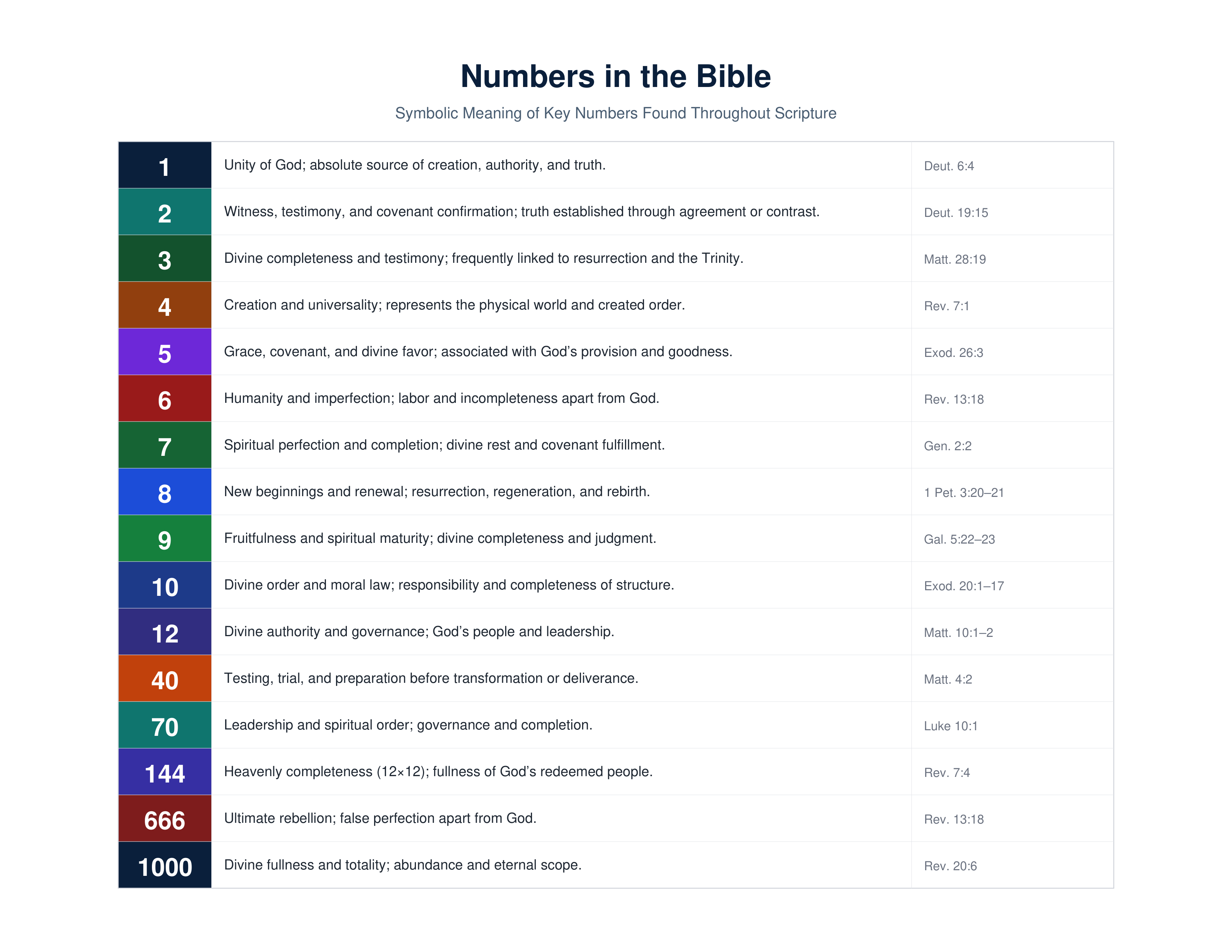
If you’ve read the Bible, you’ve picked up on the fact that a few numbers are used repeatedly in the Bible: 3, 7, 12, 40, 70, etc. A study of biblical numerology might be a fun topic for another day but not today. (I have included a woefully inadequate synopsis at the end of this post if you’re interested.) At a minimum, repeated use of certain numbers made stories easier to remember and retell—which is particularly helpful for societies that often relied on the oral rather than the written passing down of information. Add symbolism to each number and the stories and their respective meanings become even more “sticky” in your brain. For example, do you remember how long the Israelites wandered in the desert? If you didn’t remember how long but you know about numerology, you would know that the answer is probably 40 days or months or years, because the number 40 typically represents trial or testing. Conversely, if you knew what the number 40 typically represented (symbolically speaking), and you were told that the Israelites inhabited the desert for 40 years, you would understand that meant that the Israelites were in a period of testing and/or trial and/or punishment for 40 years for some reason. My point: numbers add weight to stories. They make the stories more memorable; and God uses them to weave stories and themes together throughout the Bible.
Here in Genesis 46, we see the number 70. 70 is the number in Jacob’s clan who went to Egypt to begin the Hebrew’s exile. The number 70 typically represents wholeness or completion. Think God + mankind, united together and whole. So, the fact that 70 members of Jacob’s clan went to Egypt tells me there’s a wholesome union between God and man here…a harmonic complete unit of people, marching forward with God for his intended purpose. Fast forward to the number 70 in the New Testament. In the gospel of Luke, we learn that Jesus sent out 70 disciples. These disciples would serve to flip the script, returning to the land of exile to share the good news. To put it another way, in Genesis 46, God reveals the good news to his people that they have been saved, unites with them, and they march together into the darkness of Egypt to fulfill his divine plan. In Luke 10, God unites with his people and marches into the world to give everyone the good news that they have been saved.
In Genesis, the son saves the family by bringing them out of their land and into the land of the pagans. In Luke, the father saves the world by again sending his family into the land of the pagans. That’s quite a theme—woven together in multiple ways across hundreds of pages of scripture written by multiple authors of different ethnicities over the course of thousands of years. That’s powerful. That’s memorable. That’s divine.
Here’s this week’s AI rap summary:
Scriptures taken from the Holy Bible, New International Version®, NIV®. Copyright © 1973, 1978, 1984, 2011 by Biblica, Inc.™ Used by permission of Zondervan. All rights reserved worldwide. www.zondervan.com The “NIV” and “New International Version” are trademarks registered in the United States Patent and Trademark Office by Biblica, Inc.™